The Race
In 1985 the following sled standardization was introduced by the FIBT to place all competitor on an equal footing:
Maximum Length: 2.70 m( two man) 3.80 m( four man)
Maximum Width: 0.67 m 0.67 m
Maximum Weight*: 390 kg 630 kg
*The maximum weight includes the crew. Weight bars may be added to achieve maxiumm weight.
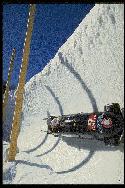
In the Olympics and other major competions, the bobsled run is at least 1,500 meters (about 1,640 yards) long and it has about 15 or 20 turns. The average slope ranges between 8 and 15 percent. A run is prepared for competition by laying wet snow over a concrete or stone foundation and then soaking the snow with water. Ice sidewalls, about 18 inches high, keep the sleds from flying off the run on straightaways. Larger turns have banks as high as 20 feet, often with an overhang of ice to help contain the sleds. A race is made up of four runs and results are based on cumulative times.
Crews push the sled to a running start from behind the starting line, but electronic timing doesn't begin until it actually crosses the line. In the four-man competition, two crew members have basically finished their work once they've leaped into the sled after the push, although they can help a bit during the run by leaning in one direction or the other to help keep the sled from skidding. Once across the starting line, a race is basically a test of the driver's ability to get the greatest possible speed out of the sled. That involves negotiating turns, including some hairpin turns of more than 180 degrees, at speeds of nearly 100 miles an hour. The brakeman, who is the rearmost passenger, brings the sled to a stop at the end of the run by engaging the brake, a toothed bar between the rear runners that bites into the ice surface.